



Choi Hyung-kuk's Hangeul Column (12) Crown Prince Sado: A Catastrophe Created by Alcohol
Alcohol...
This troublesome thing has caused much talk and trouble, but when poured on an aching heart, the world's sorrows briefly disappear, and when clinking glasses with an old friend long missed, one's generous spirit doubles. It is indeed a precious thing.
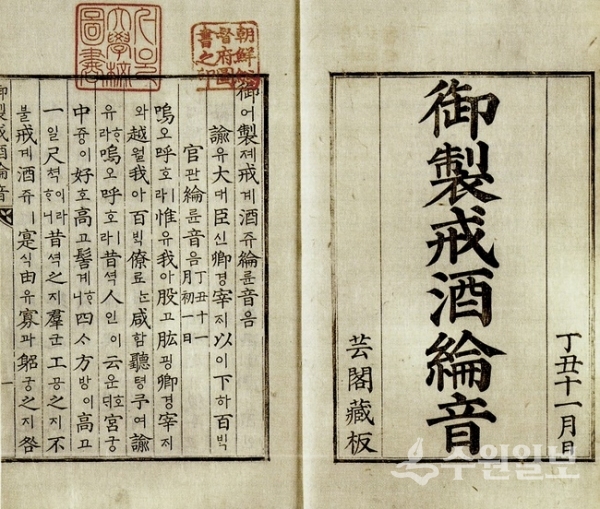
Yet prohibitions on alcohol production and consumption—absolute bans proclaimed through the voice of the king like a stroke of a brush—accompanied the Joseon dynasty throughout. Those who imbibe every morning and see their noses turn red would surely shudder at such tales.
But such was the Joseon era. When droughts and poor harvests struck, tens of thousands to hundreds of thousands of people starved to death nationwide. Using precious grain to distill alcohol when people could not fill their hungry bellies was considered a grave sin worthy of universal condemnation. Typically, when such droughts or poor harvests passed, alcohol prohibitions were naturally lifted, and people distilled liquor in their own homes for ancestral rites or on a larger scale. Near breweries, taverns overflowed from midday with intoxicated patrons.
However, King Yeongjo's reign was different. Vastly different. Caught up in suspicions of regicide regarding his predecessor King Gyeongjong, Yeongjo's rule creaked from its outset politically. In his fourth year of reign, 1728, the Musin Rebellion led by Yi Injwa erupted nationwide, dealing a fatal blow to Yeongjo's aspirations to be a virtuous king. Moreover, his biological mother, Lady Sukbin Choe, came from a lowborn background as a lady-in-waiting, so Yeongjo harbored deep-seated complexes about his own status.
For these reasons, Yeongjo determined to live as an exemplary king above all others. Fearing that officials might whisper behind his back, he felt as though he were the subject of gossip, and he constructed a daily schedule like those elementary school children make during summer vacation—living each day with absolute precision and not a moment's deviation. His life was one of such thorough discipline.
Yeongjo went so far as to promulgate the most extreme alcohol prohibition: that only sweet rice wine (醴酒) be used in all rituals, and all other alcohol be forbidden with severe punishment for violators. Sweet rice wine is a type of unfermented grain drink with almost no alcohol content—essentially just thin, weak liquid masquerading as alcohol. Moreover, those who violated the prohibition faced execution, a terrifying sword hanging overhead. Drinkers throughout the land were as good as dead.
It was in precisely this situation that Crown Prince Sado drank alcohol. And the smell of alcohol wafting from him as he studied in Nakseondang was caught red-handed by Yeongjo. This incident, followed by severe rebuke, became the starting point for the event that led to the crown prince being locked in a wooden chest and dying. On that day, the 32nd year of Yeongjo's reign (1756), the fifth lunar month, on the first day, Crown Prince Sado studying in Nakseondang set fire to that space. As the place where the crown prince had been studying burned fiercely, attendant officials summoned the Geupsuggun—the Joseon era's firefighters—to extinguish it. But Yeongjo uttered only one phrase: "Leave it be!"
After that day, the relationship between the reigning king Yeongjo and Crown Prince Sado, designated as the next king, hurtled toward catastrophe. A line had been crossed. Crown Prince Sado was then shunned from actual politics. As an alternative, Crown Prince Sado immersed himself in the compilation of a new military treatise called the Muye Sinbo (New Manual of Martial Arts). He sought to gather a new rising class of military officers through the process of compiling this martial arts treatise.
Particularly before the calamity of the Imgo year struck, he embarked on a secret journey to Pyongyang Governor's Residence. In fact, Crown Prince Sado made a secret trip to Pyongyang for nearly a month, from April 7 to May 1, 1761. The Haenghaeng Ilgi (Record of the Secret Journey) captures his cautious movements well. The diary was written by Ham Dae-il (咸載一, 1738–1771), a lower-ranking military official in Pyongyang who, recognized for his capabilities by Crown Prince Sado, served the crown prince from April 7 to May 1. The diary records specific activities during that period, allowing us to confirm Crown Prince Sado's secret Pyongyang journey that was not recorded in history. The crown prince primarily moved about the scenic sites of Pyongyang, meeting with people. Upon his return, he held a banquet at Wolparu Pavilion in Hwangju and held an archery competition. Then, on the thirteenth day of the fifth lunar month of the following year, 1762, during the Imgo Incident, he was locked in a wooden chest and died. Thus, through his death, the crown prince received the posthumous name "Sado (思悼)" from his father Yeongjo.
After much hardship, Crown Prince Sado's son Jeongjo, who ascended to the throne, changed his father's title to "Jangheun (莊獻)" on March 20, 1776, the year of his enthronement, seeking to dispel his sorrow. Jeongjo himself stated, "While 'Sado (思悼)' is a noble name, it contains only grief and longing. Therefore, I change it anew." He named the shrine dedicated to his father "Gyeongmogu (景慕宮)," and had it built in a location directly accessible from the rear garden of Changdeok Palace. Whenever Jeongjo's heart was troubled or he faced policy concerns, even past midnight, he would visit Gyeongmogu to have a silent conversation with his father.
And Jeongjo showed deep affection for people and policies related to his father. One example was martial arts. In the "Byeonggi Chongseo (Military Techniques Overview)" section of the Muye Dobo Tongji, the story of the compilation of the Muye Sinbo during Crown Prince Sado's regency is recorded in the greatest detail. The compilation of the Muye Dobo Tongji was the greatest gift that Jeongjo, as his father's son, could present to Crown Prince Sado. Since Jeongjo had promised his grandfather Yeongjo that he would never discuss the matter of Crown Prince Sado's death once he became king, he adopted this indirect method. The relevant passage reads as follows:
"In the 35th year of Yeongjo (1759), when Crown Prince Sado (小朝) took charge of state affairs, he ordered the compilation of the Muye Sinbo (New Manual of Martial Arts), and added twelve martial arts techniques: long spear with wooden handle, flagstaff spear, ceremonial sword, Japanese sword, melee combat, crescent moon blade, side-handle sword, double sword, commander's sword, Korean sword, unarmed combat, and wooden club. Combined with the original six techniques from the Muye Jebo (Various Martial Arts Manuals), this established eighteen techniques. The name 'Muye 18ban (Eighteen Martial Arts)' of the Joseon Dynasty originated from this."
Subsequently, on April 29, 1790, King Jeongjo inherited his father's legacy and added six mounted martial arts techniques practiced by cavalry, compiling the Muye Dobo Tongji containing the "Muye 24 Gi (24 Martial Arts Techniques)." Thus King Jeongjo was a monarch who sought to resemble his father even within martial arts treatises. In fact, Jeongjo was a king who displayed such superior archery skills that he was called the "Divine Archer of Joseon." He did not merely theorize or formulate policies regarding martial arts, but rather set an example himself, practicing diligently and strengthening his character.
According to historical records, Crown Prince Sado's capacity for alcohol initially did not seem particularly large. However, after that day, his heavy drinking increased beyond imagination. And Crown Prince Sado ended his life locked in a wooden chest amid numerous incidents and misunderstandings that arose from alcohol. Whether for this reason or not, his son Jeongjo also favored strong spirits. Jeongjo's famous saying "Budwi Muigwi (不醉無歸)—'Do not return home unless drunk'"—was born from such circumstances.
As a humorous tale has it, when a drunk frog becomes completely intoxicated, the first thing it says with a slurred tongue is "Hey! A snake!" Such is what happens when one serves the 'Lord Alcohol.' Alcohol flows smoothly when enjoyed in moderation according to circumstances, but when consumed to the point where one cannot distinguish whether a person is drinking alcohol or alcohol is drinking the person, it is no longer alcohol but poison. If one keeps falling into the jug of alcohol, one may end up receiving only a fragrant wine cup year after year.



Loading comments…