



Kim Chung-young's Suwon Microscope (123) King Jeongjo's Hwaseong Journey (3) Fifth Day: Sixtieth Birthday Celebration Banquet, Sixth Day: Encouragement for Local People and Participants
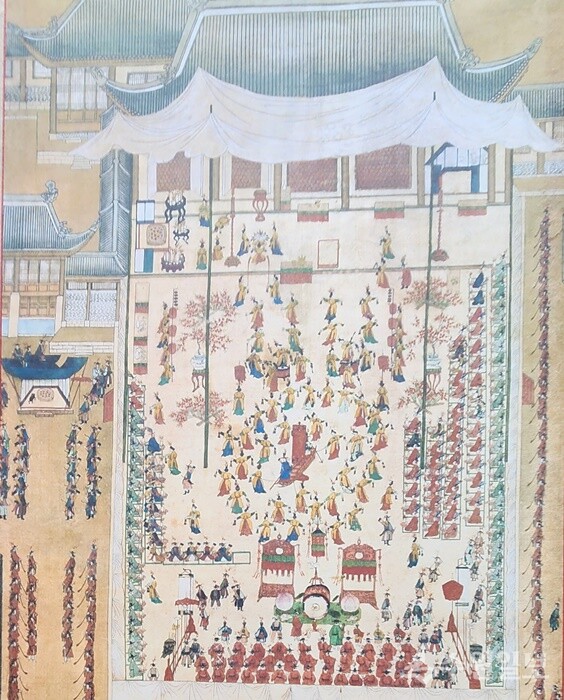
The fifth day of the Hwaseong Journey (the 13th day of the second lunar month) was marked by the jinchanrye (royal banquet ceremony), the highlight of the eight-day journey. On the sixth day (the 14th day of the second lunar month), events were held to distribute rice to the poor and to host a feast honoring the elderly of the region. Following this, King Jeongjo conducted an inspection tour of Hwaseong. In the afternoon, he held an archery contest with his attending officials and offered words of encouragement. With this, the four-day schedule in Hwaseong came to a complete end.
The fifth day (the 13th day of the second lunar month) marked the highlight of this journey: a sixtieth birthday celebration banquet for the king's mother, Hyegyeong Palace Hong. This day was devoted entirely to honoring the queen mother. The banquet began around 9 a.m. at Bongsudang.
A canopy was erected in the courtyard of Bongsudang, and seats for Hyegyeong Palace and King Jeongjo were prepared in front of Bongsudang Hall. Hyegyeong Palace's seat was covered with a lotus-patterned cushion, behind which was placed a ten-symbol longevity folding screen. King Jeongjo's seat was covered with a leopard-skin cushion, behind which was placed a blue-and-red painted folding screen.
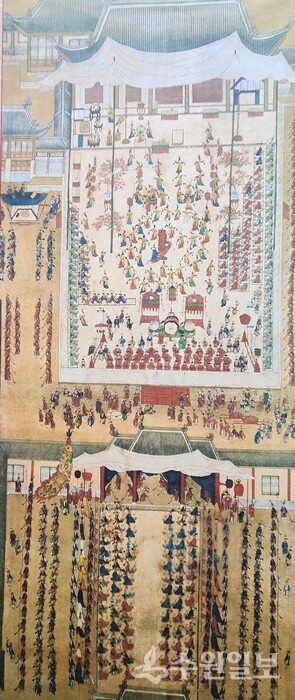
Tables bearing items necessary for the banquet were arranged, and implements to be presented to Hyegyeong Palace were positioned. Female court officials, female attendants, and female musicians entered first and stood at attention. Then ceremonial officials, relatives of the royal house, and accompanying officials entered in military dress and took their places. The inner and outer court ladies stood in their designated positions. Once the seating was arranged, the female attendants proceeded to Hyegyeong Palace to announce that preparations were complete.
When Hyegyeong Palace and King Jeongjo made their entrance, the Yeomminnak music was played. As they took their seats, incense was lit and the music ceased. A handkerchief was presented to Hyegyeong Palace, and after the ritual of offering food and flowers was completed, all bowed and rose. King Jeongjo then raised a wine cup and offered words of praise. Hyegyeong Palace declared, "I share this auspicious occasion together with Your Majesty," and took a drink.
King Jeongjo proceeded to the kowtow position, performed three prostrations to show his respect, and sang "Cheonse Cheonse Cheoncheonse" (a congratulatory chant). All participants joined in. King Jeongjo returned to his seat. A handkerchief, cups for wine, and flowers were presented to him as well. Food and flowers were then distributed to all participants, and dances and music were performed. After the cups were cleared, King Jeongjo and the participants again moved to the bow position, paid their respects to Hyegyeong Palace, and departed.
After the banquet ended, King Jeongjo summoned the Prime Minister and all the officials of the State Council. He addressed them, with Councilor-General Hong Nak-seong and others present, saying: "As a young man, I have prepared for several years in anticipation of today's banquet. The weather is clear, and my mother's health remains strong—how can I fully express my joy and delight? He then ordered that food and flowers be distributed to all the officials.
He summoned the royal secretaries, historians, and other officials, instructing Royal Secretary Yi Man-soo to compose a poem from the throne, and directing the officials who participated in the banquet to compose verses in response.
He further declared: "Today's ceremony is truly an auspicious occasion that occurs once in a thousand years. In the coming year of gyeongja, my mother will reach her seventieth birthday. In ten years' time, when this auspicious occasion returns again, we shall celebrate once more."
The sixth day (the 14th day of the second lunar month): On the sixth day of the Hwaseong Journey, events were scheduled including the distribution of rice to Hwaseong residents, a feast honoring the elderly in the morning, an inspection of Banghwa Suryujeong in the afternoon, and an archery contest at Deukjung Pavilion in the late afternoon.
The distribution of rice to Hwaseong residents had been carefully planned in advance. Recipients included the four classes of people (farmers, artisans, merchants, and the poor), widows, widowers, orphans, and only children. Rather than distributing rice in one location, the rice was distributed at four different places. In the urban area, King Jeongjo personally presided over the distribution at Sinpung Pavilion of the Palace, while officials were dispatched to granaries in surrounding areas to distribute the rice there.
At this time, one-tenth of the 60,000 residents of Hwaseong received rice, totaling 368 stone measures, demonstrating that this was not merely a formality. King Jeongjo took a seat on the second floor of Sinpung Pavilion. He instructed the eastern vice-secretary Yi Jo-won, saying: "Go down and distribute the rice and the porridge in equal amounts. Make sure to inform them that the rice and porridge come from my mother's compassion." King Jeongjo also asked for the porridge to be brought to him to ensure it was not served cold.
King Jeongjo then instructed Royal Secretary Yi Man-soo: "Today's elderly feast is held to show respect for the aged, so the elderly should not have to wait long outside. I shall go to Naknam Hall, and you remain here. When the people arrive and wait, serve them porridge one by one, and ensure that even those who arrive late are not served cold porridge." In this way, King Jeongjo's love for his people was extraordinary.
The second event was a feast prepared for the elderly.
Since the eight-day Hwaseong Journey was undertaken for the sixtieth birthday celebration of the king's mother, it was necessary to comfort the elderly residents of Hwaseong. The elderly banquet guests included Councilor-General Hong Nak-seong, who had come down for the journey, fifteen elderly court officials, and 384 elderly residents of Hwaseong.
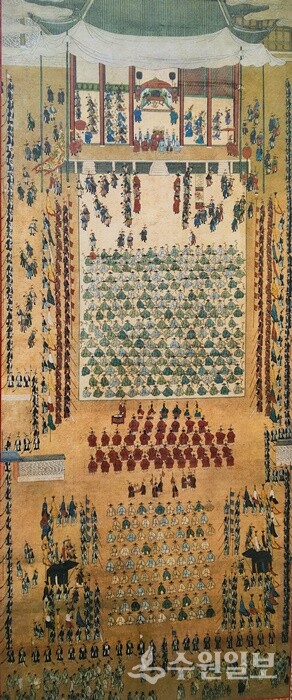
When the drum signaling the completion of preparations sounded, King Jeongjo donned military dress and emerged to sit in Naknam Hall. The elderly officials who had come down from Seoul climbed the steps leaning on their staffs. Those of the second rank and above entered within the columns, while those of the third rank and below sat on the steps. The remaining elderly residents, supported by their descendants, sat at the base of the steps.
King Jeongjo distributed yellow silk handkerchiefs to be tied to their staffs and gave each a bolt of silk, then had food brought out and court music performed. He had a poem from the throne displayed and invited the participants to compose response verses. He also ordered that elderly residents of Hwaseong without official status who had not been invited should be brought in. He instructed that if there were elderly people among the tourists, they should be treated to drinks and food. When Chai Je-gong remarked that half of the crowd appeared to be elderly, King Jeongjo responded that auspicious occasions are all the better with large numbers of people. As food was distributed to them as well, they shouted "Cheonse" (long live the king).
King Jeongjo took time for a detailed inspection of Hwaseong.
As the scheduled events drew to a close, King Jeongjo found time for leisure. He traveled to Banghwa Suryujeong, the most beautiful pavilion in Hwaseong. This location, in harmony with Jangan Gate, Hwahong Gate, Yucheon Stream, Yongryeon Pond, and Gwanggyo Mountain, ordinarily offered a picturesque landscape that evoked poetic sentiment, but it also served as a strategic defensive point in the northeast of Hwaseong.
Moreover, this pavilion has a distinctive design, with its floor plan in the form of a swastika and its roof folded three times to converge at the center in a steeple-like form. At this location, King Jeongjo appeared deeply moved and remarked: "If the Jangyong Outer Corps had not worked with utmost sincerity, how could such excellence have been achieved? Finding such an excellent general fills my heart with great joy."
The final event of the Hwaseong Journey was an archery contest with attending officials at Deukjung Pavilion. King Jeongjo excelled not only in scholarship but also in martial arts and archery. Archery was more than a mere martial skill—it was a method of spiritual discipline.
On this day, King Jeongjo was unquestionably the victor in the archery contest. While his officials may have deliberately yielded to him, it was true that King Jeongjo's archery skill was superior. He displayed humility by remarking: "Although archery is said to be one of the Six Arts, it is nonetheless still merely a technique. Four years have passed since I last practiced it, so today's accuracy is merely chance," thereby showing modesty.
Upon seeing the elderly Hong Nak-seong, King Jeongjo said: "That you, an elder of eighty years, have hit three targets is truly remarkable," and offered him words of encouragement. King Jeongjo provided an evening meal for his officials. After the meal ended and dusk fell, he ordered preparations for night archery. Small targets were set up with two torches placed on either side. King Jeongjo shot twice and hit five targets.
After the archery contest ended, fireworks were set off at Deukjung Pavilion. With the archery contest at Deukjung Pavilion, all events in Hwaseong came to an end.
The four-day schedule in Hwaseong was, as King Jeongjo himself said, "cheonjaeiluji-hoe" (千載一遇之會—an opportunity that comes once in a thousand years), a completed event of historic significance.
We invite you to encounter King Jeongjo and experience "cheonjaeiluji-hoe" (千載一遇之會—an opportunity that comes once in a thousand years) at the Hwaseong Cultural Festival.
Loading comments…