



Gwanggyo Column by Kim Woo-young The Portrait of King Jeongjo, and the Portrait of King Sejong
On May 16, Suwon Ilbo reported in an article ('New Portrait of King Sejong Unveiled on His Birthday, Designated as the First National Commemorative Day') that Lee Jun, the 21st direct descendant of King Sejong, unveiled a newly created portrait based on historical and scientific analysis.
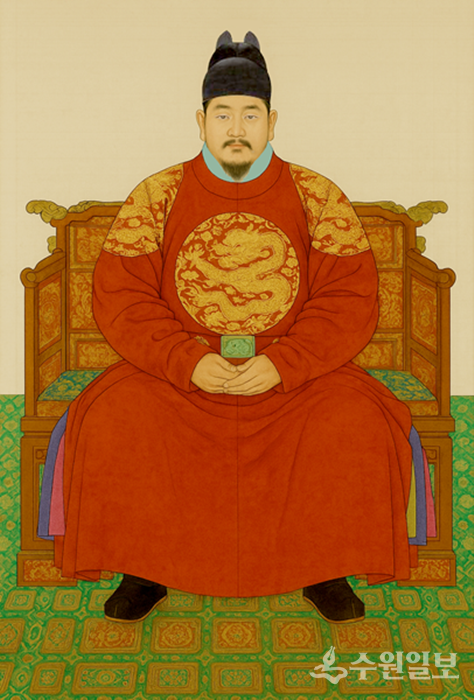
On the occasion of the first National Commemorative Day commemorating 'King Sejong's Birthday' (May 15), the portrait unveiled was reportedly redrawn through more meticulous historical facts and scientific analysis.
The portrait was redrawn by carefully analyzing the portraits of King Sejong's relatives—Yi Seong-gye (founder of Joseon), Prince Uian, Princess Gyeongsin, Prince Hyoryeong, and King Sejo—and synthesizing physical descriptions from historical records.
It was produced realistically by considering King Sejong's lifestyle habits, such as his fondness for meat, and his physique, and his clothing also underwent precise historical verification.
In fact, it was revealed that during his reign (1418–1444), King Sejong wore a blue dragon robe rather than a red one.
The portrait of King Sejong unveiled that day is expected to be used as the official portrait for King Sejong's direct imperial line and the six families of Sagado Dogseo.
The newly drawn portrait of King Sejong is not a government standard official portrait. The standard official portrait is one designated by the Minister of Culture, Sports and Tourism to prevent a proliferation of portraits of revered historical figures.
It is recorded that there were several portraits of King Sejong, but none currently remain. Therefore, we cannot know what King Sejong's face looked like. The current standard official portrait was designated in 1973, painted by artist Kim Ki-chang of the Unbo school, who was later found to have pro-Japanese activities. It is the portrait of King Sejong that appears on the current 10,000 won banknote. In other words, it is an imaginary portrait.
Of course, the newly unveiled portrait is also an imaginary portrait.
However, as explained earlier, it underwent meticulous historical and scientific analytical procedures. In addition to this, relatives' portraits and lifestyle habits, physique, and clothing were all considered, so it is likely the portrait most closely resembling King Sejong's actual appearance.
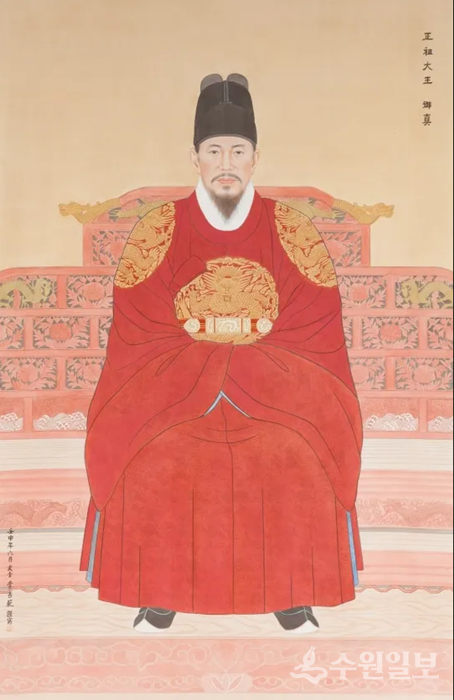
The portrait of King Jeongjo is also an imaginary portrait.
The portrait of King Jeongjo currently enshrined at Hwaryeong Hall was painted by Korean painter Lee Gil-beom of Suwon and is designated as the standard official portrait.
The original portrait was lost in the major Busan Yongdu-dong fire that occurred in 1954. There is currently no portrait of King Jeongjo that remains.
Accordingly, artist Lee Gil-beom imagined King Jeongjo's face in 1989 and painted the portrait, which was officially designated as the standard official portrait.
The face of King Jeongjo expressed in this painting is of a slender, handsome type. It closely resembles a certain actor who frequently appears in historical dramas.
Of course, it is entirely a portrait imagined by the artist. And since there is no one living who met King Jeongjo, it is impossible to take issue with it.
However, his son, King Sunjo, reminisced about his father's appearance in the following way.
△The back of his head resembled his father King Yeongjo's. △His eyes were puffy around the sockets, his mouth was square, his nose was high, and he had a double chin. △He looked older than his peers.
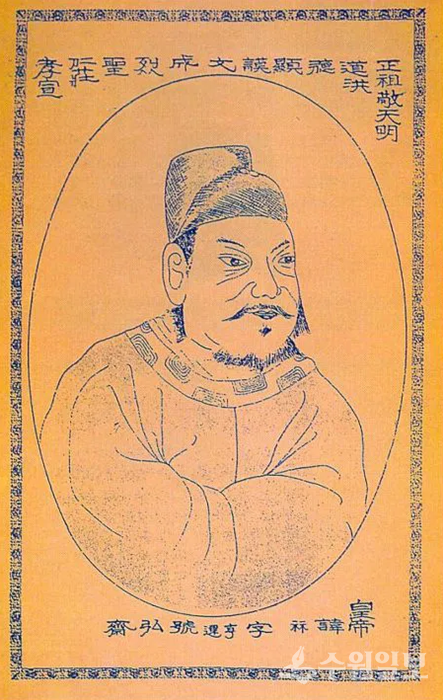
The portraits of King Jeongjo published in 'Seonwon Bogam' and 'Yeolseong Eojin' are greatly different from the standard official portrait. The portraits of King Jeongjo depicted in Seonwon Bogam and Yeolseong Eojin resemble many aspects of King Sunjo's recollections.
King Jeongjo may be displeased, but rather than conveying the impression of a scholar, court official, or handsome man, the portrait gives the impression of a robust and wild military officer.
I myself remember being taken aback when I first saw the portrait in Seonwon Bogam.
Of course, the faces of King Jeongjo depicted in Seonwon Bogam and Yeolseong Eojin cannot be said to be accurate. It is a fact that the portraits recorded in Seonwon Bogam and Yeolseong Eojin were often painted differently from reality.
Nevertheless, the current standard official portrait differs greatly from his son King Sunjo's recollections.
Therefore, why not adopt the method employed by Lee Jun, the 21st direct descendant of King Sejong, who drew a new portrait of King Sejong based on historical and scientific analysis, and create a new portrait of King Jeongjo as well?
Loading comments…