



Kim Woo-young Gwanggyo Column Why Hasn't This Sacred Zelkova Tree on Hwaseong Fortress Wall in Haenggung-dong Become a Protected Tree?
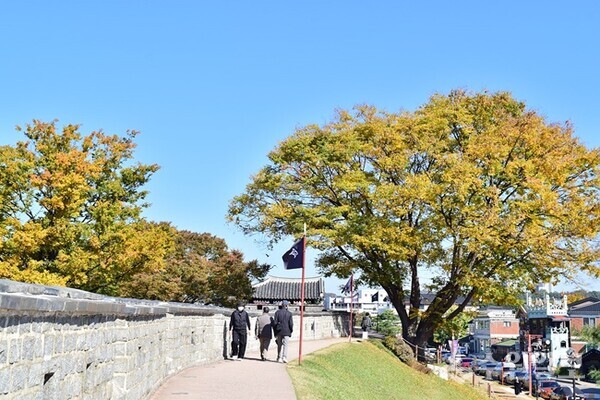
Midway along the Hwaseong Fortress Wall connecting Jangan Gate to Hwaseo Gate stands a massive zelkova tree. With a circumference of 4.5 meters at chest height, it has a towering appearance, yet it has not yet been designated as a protected tree.
When I was attending Suwon North Middle School, I lived for a time in a tin-roofed room behind a rice mill connected to a car repair shop outside Jangan Gate. This tree stood behind the house of a friend I occasionally visited.
After going to a different high school, I never saw that friend again. His father, I was told, was a traffic police officer. The sight of him occasionally arriving on a traffic police motorcycle, called a sidecar, looked impressive.
Even then, this zelkova tree was massive.
In 2014, poet Shin Kyongrim published a poetry collection titled "The Second Floor of a Photography Studio," which includes a poem called "The Zelkova Again."
After many years had passed, I went back to my hometown,
And the zelkova tree in front of my childhood home had grown large again.
I soon realized I had grown old and frail,
My eyes already dimmed and my ears grown deaf,
Yet I did not grieve.
Looking through eyes that saw the zelkova grow again,
The world was so beautiful.
With eyes dimmed and ears deafened,
The whole world became even more beautiful.
I felt the same way. Now, having passed both my sixties and beyond and into my seventies, looking through eyes that have shed even a little desire, this tree appears ever more massive. Moreover, it stands with confident bearing. It is beautiful. It shows no signs of the hollows or broken branches that old trees typically have, appearing healthy instead.
This tree appears to be over 200 years old.
Its location on the fortress wall between Jangan Gate and Hwaseo Gate makes it seem like a strong general protecting Hwaseong Fortress.
Or perhaps, it is an embodiment of the spirit of Hwaseong, a UNESCO World Heritage site, appearing in benevolent form.
Especially in the twilight evening, looking up from below the fortress, it evokes a sense of warmth rather than fear. It harmonizes beautifully with the Hwaseong Fortress Wall and the Haenggung-dong village, pleasing to the eye.
It seems I am not alone in feeling this way. Whether day or night, young people sit beneath the tree, laugh brightly, rest, and take photographs with it as their backdrop—testament to the benevolent energy of this tree.
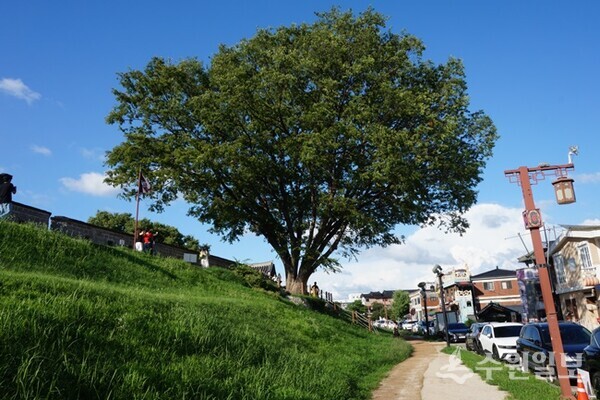
The zelkova tree must have witnessed the joys and sorrows of the people of Suwon who lived within the fortress. Does it remember when my friend, who lived beneath it, was born, or when he and I scrambled like squirrels through the crumbling gaps in the fortress wall?
But why does this zelkova tree stand on top of the fortress wall rather than at the village entrance, in the middle of the neighborhood, or in front of government offices?
Hwaseong is an "inner-backing" style fortress wall with an outer face of stone and an inner core of earth.
According to Dr. Han Dong-min, director of Suwon's Independence Movement Memorial Museum, trees were planted during construction to prevent the inner earth portion from collapsing. Various historical records also show evidence of trees being planted around fortress walls and facilities.
In 2019, the Suwon City Research Institute published "Research on Storytelling of Plant Resources Related to Suwon." According to research fellow Kim Eun-young, the author, "King Jeongjo's tree-planting projects in Suwon were conducted mainly in the Hyungnyung-weon area, but according to the 'Hwaseong Fortress Construction Records,' trees were planted seven times in total across spring and autumn from 1794 to 1797 at locations including Paldal Mountain, Maehyang-dong, throughout the fortress inner-backing, both sides of the wall, Daecheon, outside the fortress at Yongyeon, Gwangil-ya, and areas north of Younghwa-jeong." Here, "inner-backing" refers to the inner portion of the entire fortress, and "Daecheon" is the Suwon Stream.
The same book documents trees planted around fortress facilities: hackberry, willow, peach, mulberry, pine, and plum trees. However, there is no record of zelkova trees being planted. Perhaps only the most commonly planted species were recorded, and zelkova was omitted. Or perhaps it was planted later.
The appearance of dense rows of trees along the fortress wall is confirmed in old photographs. In particular, the black-and-white film "School Fees," taken in 1940 during Japanese colonial rule and depicting Suwon and Hwaseong Fortress, shows trees densely planted on the fortress wall and around the Yeonmudae training ground, Changnyong Gate, and Hwaseo Gate.
"School Fees" is a film shot on location at Maehyang Elementary School in Haenggung-dong, Paldal-gu, Suwon (now Maehyang Girls' Middle and High School). It was produced by Yi Chang-yong of Korea Film Company and co-directed by Choi In-gyu and Bang Han-jun. The starring roles were played by Jung Chan-jo and Kim Jong-il.
Shot entirely in Suwon, it is a precious visual record revealing what Suwon was like at that time.
In June 2014, the Korean Film Archive acquired a 35mm print from the China Film Archive, and after restoration work, it was released in theaters and on DVD in 2015. I myself watched the film at a screening held by Suwon City Hall.
Most of the numerous trees that appeared in the film or were captured in old photographs have vanished. The straight trees were felled by the Japanese, and some were cut down during the Korean War by refugees who used them to build makeshift shelters or as firewood for heating and cooking.
The Hwaseong Fortress Wall was also severely damaged during that time. Refugees who settled beside the fortress took the stones and bricks from the wall to build their homes. There are even accounts that refugees tore down the kitchen buildings of Hyungnyung-weon and Geonnyung-weon and burned them as firewood.
Although the tall pines on the fortress wall have disappeared, this zelkova tree survived without being cut down. No matter how cold and hungry those times were, perhaps this sacred tree alone could not be touched.


Loading comments…