



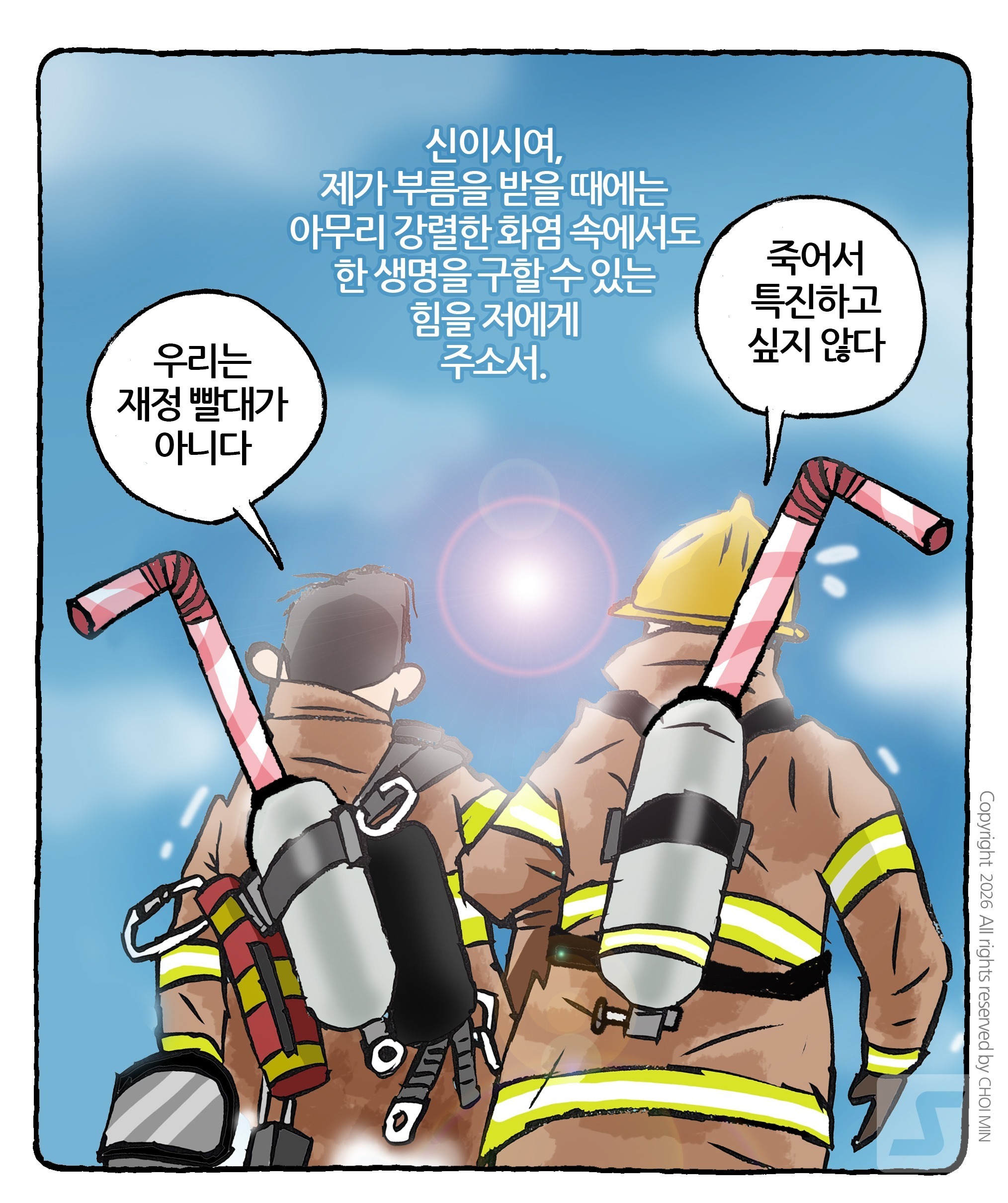
Editorial Firefighting is Not a 'Financial Straw'—Fulfill the Promise of State-Level Service
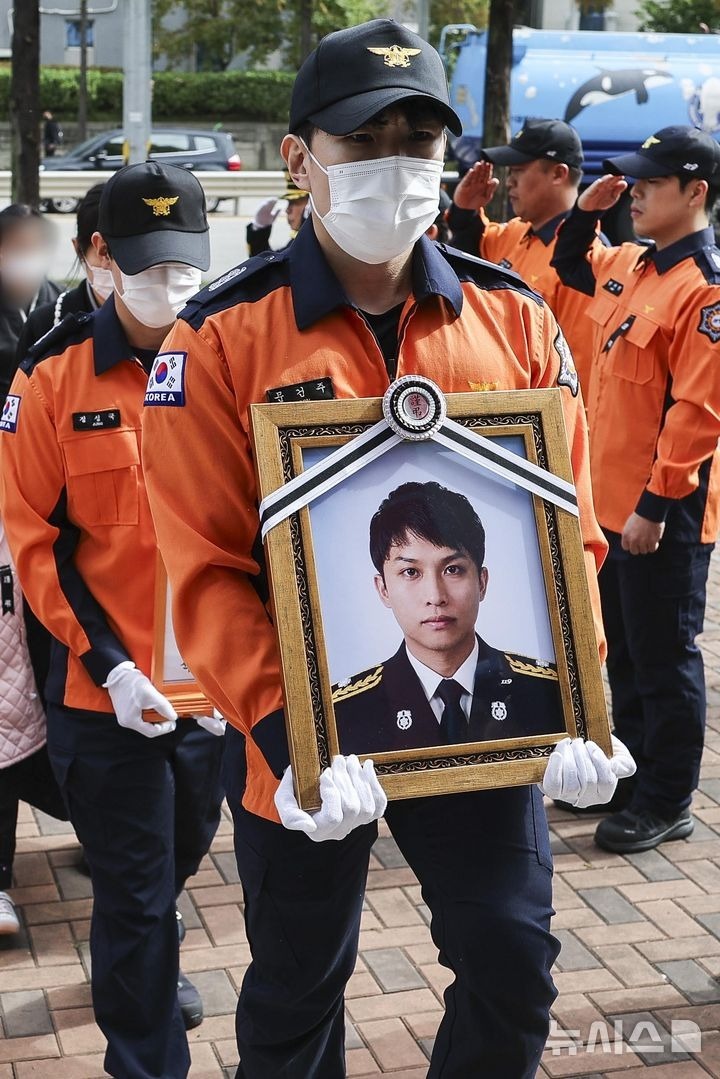
On the 19th, the day of the funeral service for a fallen firefighter, Democratic Party Rep. Bu Seung-chan stated during a Gyeonggi Province parliamentary audit by the National Assembly's Land, Infrastructure and Transport Committee: "Isn't (the fire service) really sucking up finances?" His remarks came while defending Governor Choo Mi-ae's comment about the fire service being a "financial straw." Six days after Gov. Choo bowed her head to firefighters in apology, a fellow party member dusted off the same language. It was the day farewell was being paid to the late Captain Kim Jin-seok, who died while suppressing a factory fire in Bucheon.
We understand the intent behind his words. Rep. Bu pointed out the reality that local governments bear roughly 90 percent of firefighter personnel costs and support expenses, calling for national-level solutions. The direction itself is not wrong. The problem is the language. Expressions like "straw" and "sucking up finances" contain an underlying view that treats firefighting not as the subject of public safety but as a fiscal burden. When sound arguments are made in wrong words, the argument itself becomes suspect.
Firefighters became state-level civil servants on April 1, 2020. This change came through the enactment and revision of six related laws in November 2019, including the Firefighter Civil Service Act, the Fire Services Basic Act, and the Local Transfer Tax Act. There was one reason: fires do not discriminate by region, yet firefighter treatment and equipment varied depending on local fiscal circumstances. The true purpose of this transition was to eliminate the contradiction of different treatment while performing the same national duty, and to ensure that residents in any region would receive the same level of firefighting service.
However, only the employment status became state-level; the structure remained unchanged. Fire services remain local autonomy affairs under the Local Autonomy Act, and the national budget share of this year's fire service budget stands at only 10.7 percent. Local governments bear over 90 percent of personnel costs. Six years have passed with the national budget share of personnel costs rising only to 9 percent from the pre-transition level of 1 percent. As a result, 4 out of 10 protective equipment items have exceeded their useful life, and next year's fire safety transfer tax will be cut by 27.6 percent. In Gyeonggi Province alone, firefighting personnel costs in 2027 are projected to reach 1.1 trillion won. Financial conflict is an anticipated collision created by this ambiguous structure.
Therefore, discussion on expanding national budget allocation is necessary. However, the starting point must be different. If the logic is one of passing the buck—"the metropolitan region's finances are strained, so the central government should take it on"—then the moment central finances become difficult, firefighting will once again be pushed to the back burner. The reason the state should take responsibility for fire service finances is not the condition of local treasuries. It is because citizens, regardless of where they live, must receive the same level of firefighting service, and for that, a stable financial structure independent of economic and regional fiscal conditions is required. That was precisely the promise the state made to citizens and firefighters through the transition to state-level service.
What the National Assembly must do is not compare firefighting to a straw, but complete that promise through legislation. It must clarify state responsibility for fire services and provide legislative support through a roadmap for phased national budget conversion of personnel costs and a plan for stable expansion of the fire safety transfer tax. The words that should have been spoken at the parliamentary audit on the day of the fallen firefighter's funeral were not "sucking up finances" but "we will take responsibility."


Loading comments…