



Gyeonggi Province Enters Era of 5.57 Million Middle-Aged Adults...Discussion Grows on Gyeonggi's Role in Finding Alternatives
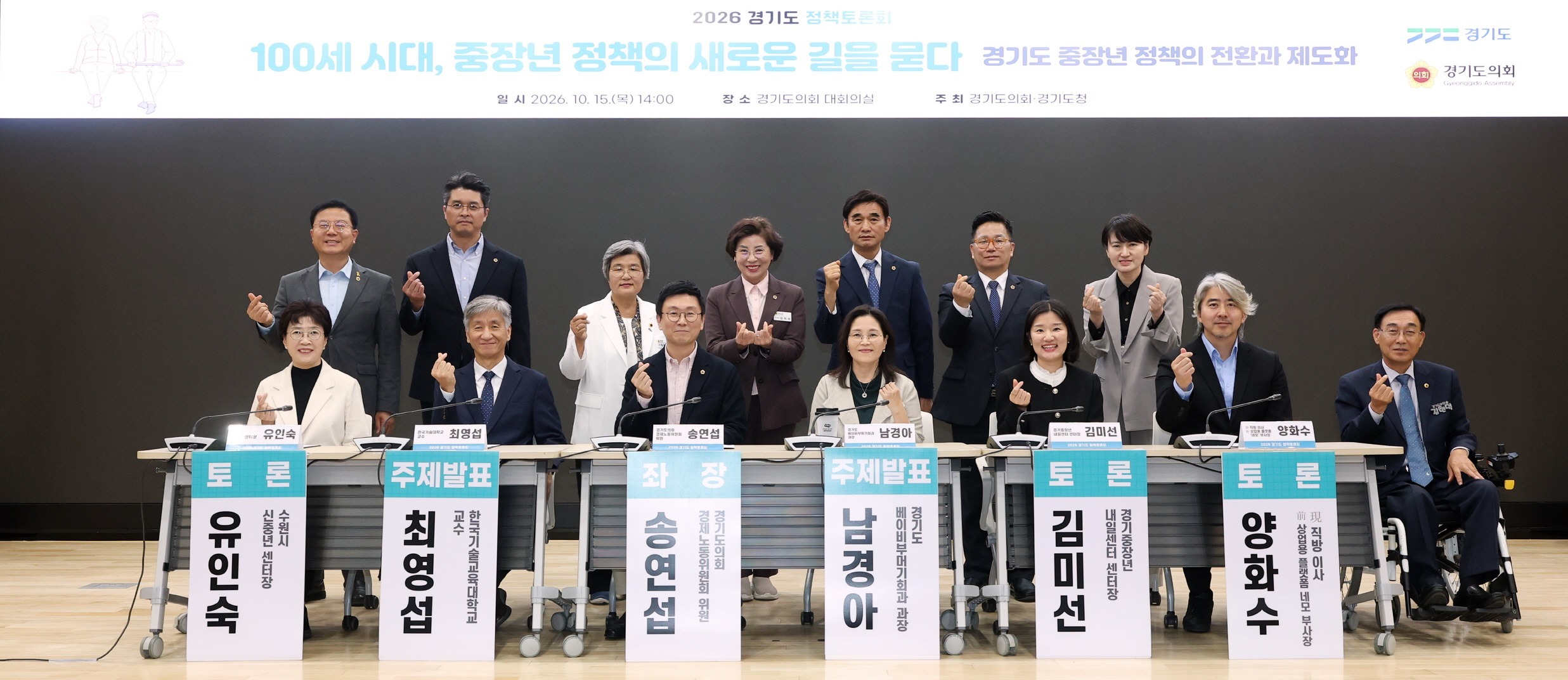
Discussions are now in full swing on the utilization of human resources among retiring middle-aged residents, who account for 4 out of every 10 residents of Gyeonggi Province, totaling 5.57 million people.
Provincial Councilor Song Yeon-seop (Democratic Party, Proportional Representation) of the Economic and Labor Committee of the Gyeonggi Province Assembly chaired the policy forum "100-Year Lifespan Era, Asking for a New Path in Middle-Aged Policy" held on the 15th in the main conference room of the provincial assembly, discussing the next phase of Gyeonggi Province's middle-aged policies.
The forum, jointly hosted by Gyeonggi Province and the Gyeonggi Province Assembly, was organized to build on the achievements of middle-aged policies that Gyeonggi Province has been pioneering and to find future directions, with attendance of about 100 Gyeonggi residents interested in middle-aged policies.
Since 2023, Gyeonggi Province established the nation's first dedicated department for middle-aged affairs and has since developed new policy models such as light jobs and internships.
The forum also reflected the intent to expand Gyeonggi Province's experience to become a national standard, as discussions on enacting the "Middle-Aged Basic Law" are underway in the National Assembly.
Professor Choi Young-seop of Korea University of Technology Education, who gave the keynote presentation, stated, "If we increase the proportion of middle-aged capability utilization by 1 percentage point each year, it would have an economic effect equivalent to investing approximately 1.8 trillion won annually," and added, "The role of local governments that understand regional circumstances is important, and if Gyeonggi Province creates effective alternatives, there is a great possibility for nationwide expansion."
Nam Kyung-a, director of the Baby Boomer Opportunity Division of Gyeonggi Province, introduced the achievements of light jobs (3,047 applicants) and internships (57.3% regular employment conversion rate). She then presented a mid-to-long-term direction of broadening the policy framework from "second act of life" to "life transition rights."
In the designated discussion that followed, concrete proposals from the field continued. Yoo In-sook, director of the Suwon New Middle-Age Center, presented a plan to establish provisions in ordinances for provincial budget support to install new middle-age centers in all 31 cities and counties.
Kim Mi-sun, director of the Gyeonggi Middle-Aged Tomorrow Center, argued that short-term support projects make it difficult to lead to regular employment and demanded financial planning on a minimum three-year basis.
Yang Hwa-soo, executive director of Jikbang, proposed that instead of asking "where to rehire them," the question should be "where to redeploy their careers," suggesting support for career transition while employed.
Councilor Song Yeon-seop stated, "The 5.57 million middle-aged residents in the province account for 4 out of every 10 residents, but they must endure an income gap of over 10 years between leaving their primary jobs at an average age of 52.9 and receiving pensions."
He continued, "Since Gyeonggi Province has been opening the path first, now is the time to establish a stable system where projects continue consistently year after year rather than changing annually," and emphasized, "An institutional foundation is needed that views middle-aged residents as human resources to jointly lead the regional economy."
Loading comments…