



Special Interview Dae-hee Han, Head of Gwangju Yeokdong Residents Council
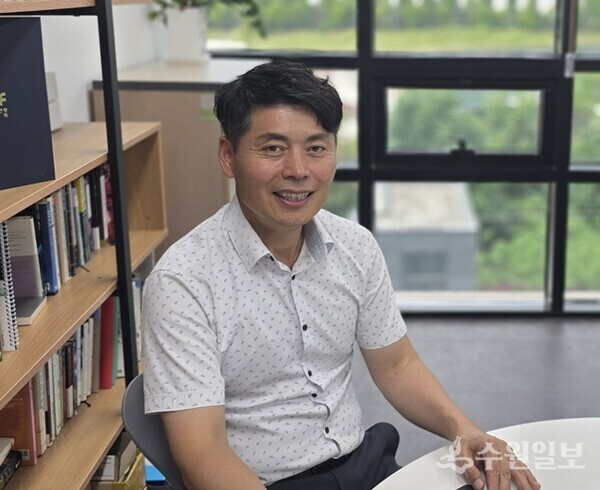
[Suwon Ilbo=Reporter Um In-yong] Dae-hee Han, Head of the Gwangju Yeokdong Residents Council, is so busy these days that he feels he would need ten bodies. However, Han says he naturally enjoys his work, so he considers having plenty of tasks to be a blessing and is giving his utmost effort.
As a former track and field athlete, he has built connections through his work as chairman of the Gwangju Track and Field Association, and is actively engaged in various organizations including serving as head of the Cheongju Han Clan United Association, chairman of the "Together Arirang" volunteer committee, and operating committee member of Gwangju Jungang High School.
Recently, Han has taken on the role of head of the Gwangju Yeokdong Residents Council as a native of his hometown, driven by the belief that original residents should not be harmed by one-sided, forceful projects carried out under the pretext of public development, as various areas throughout Gwangju undergo reconstruction and redevelopment. He has been advocating for residents' voices.
We met with Dae-hee Han, Head of the Gwangju Yeokdong Residents Council, who works tirelessly with citizens' lives and at the grassroots level.
- What is the direction for Gwangju Station area development?
▲ I believe that Gwangju Station area development should not simply become a bedroom town with only ultra-proximity apartments, but rather should be reborn as a core landmark for Gwangju to broadly reflect residents' opinions, pursue long-term policies rather than short-sighted ones, look toward future generations, and activate the local economy.
- The development is divided into two branches centered around Gwangju Station. If you analyze it specifically?
▲ The Gwangju Station area development was initially designed with exits 1 and 2, not as densely packed "chicken coop apartments," but I believe policies are needed to create leisurely spaces for citizens alongside parks. Yet it's impossible to tell who these policies are being pursued for.
Exit 1 consists of commercial districts and semi-residential land development, while Exit 2, centered on Gyeongan Market—the heart of Gwangju—will become an old city center if only apartments are built without parks.
There is no connection with the station area, the grade has been raised to stage 4, citizens' quality of life is rapidly declining, and projects like the extension of the Yongin-Gwangju Gyeonggang Line and high-speed rail construction between Seo and Gwangju are being pursued, with new transfer stations even emerging. Yet public enterprises are still pursuing outdated station area development that goes against urban development trends. I believe such policy development should be reconsidered going forward.
- The Gyeonggi Housing and Urban Development Corporation (GH) is pushing the project forward as public development?
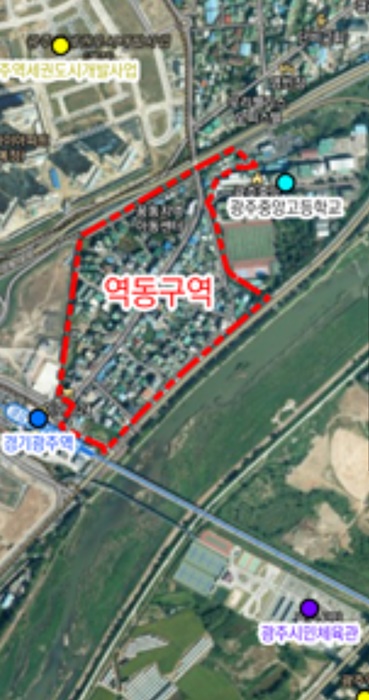
▲ Yes. The Gyeonggi Housing and Urban Development Corporation (GH) is pursuing the Yeokdong Redevelopment Project in Gwangju on Yeokdong 141-6, covering 111,000 square meters as public development. Currently, they are providing landowners with information on the project background, district planning proposals, estimated contributions, and future schedules.
In this process, most residents point out that if ultra-proximity sites are filled only with apartments without self-sufficient facilities, it will become a 'bedroom town' and, frankly, as the expression goes, a 'chicken coop.' Filling it only with apartments will make the downtown area stuffy, and connections with surrounding areas will be cut off. Green parks should be installed nearby to provide more comfortable rest spaces, but it seems the relevant agencies are only focused on profit over residents' convenience. From a long-term perspective, this goes against the purpose of local economic development and station area development.
Furthermore, GH presented a mixed-use complex with shops in front of the station in the first briefing session, but changed it to an all-apartment complex (35 to 45 stories) with some commercial housing in the back in this second session. Such inconsistent policies pursued with administrative convenience are simply incomprehensible.
- What are residents' opinions? Please be specific.
▲ If the development of Gwangju Station area—Gwangju's face—is pursued by simply filling it with apartments, it can only become a bedroom town. Green spaces must be boldly secured around the station. Through consultation with residents, green spaces should be created through donation dedications. This would raise not only the station's image but also its brand value considerably.
Since the Yeokdong area of Gwangju borders nearby Seongnam, Icheon, and Yongin cities, it should be developed as a landmark with commercial and business facilities that coexist to create employment and activate the local economy. This would raise the city's dignity and value, and future generations would have pride in it.
- By the way, what does it mean that Gyeonggi Province ordinances propose lowering the resident consent rate from the existing 67 percent to 50 percent under the Urban and Residential Environment Improvement Act?
▲ That means confiscating residents' property. Because lowering the resident consent rate removes residents' right to defend themselves. Looking at the superordinate Urban and Residential Environment Improvement Act, the existing resident consent rate is 67 percent, but Gyeonggi Province is making it so that projects can proceed if only 50 percent resident consent is obtained through its ordinance. I don't know who this policy is for. It greatly violates fairness, and if regulations change depending on circumstances at any given time, it's unfortunate that innocent citizens end up being harmed.
- There is criticism that the initial land compensation was set absurdly low?
▲ Gwangju's Yeokdong area is where residents have lived for hundreds of years, passed down through generations. During the first phase of the initial station area project, land was taken at an unreasonably low rate of 1.5 million won per pyeong, and demanding sacrifice only from landowners under the pretext of public interest is undoubtedly a major problem.
In a situation where land prices throughout Gwangju City are rising recently, how can original residents who receive low land compensation go and live elsewhere?
Loading comments…